
Programmes

Programmes

Every student begins with different strengths, interests and areas for development. These age groups show the kinds of skills and activities I commonly teach, but each student’s programme is planned individually and adapted as they progress.

An open book, clothbound books and a notebook on a wooden desk beside a sunlit study window.

An example curriculum

Inside a Programme

This is the curriculum behind the Kensuke’s Kingdom lessons and writing featured on our Student work page. It shows how those lessons sit within a wider programme, building on earlier travel writing and leading into poetry and comparison.

The 20-lesson overview connects reading, writing and grammar across a sequence of projects. Each project builds on skills introduced earlier, with the order and pace adapted as the student progresses.

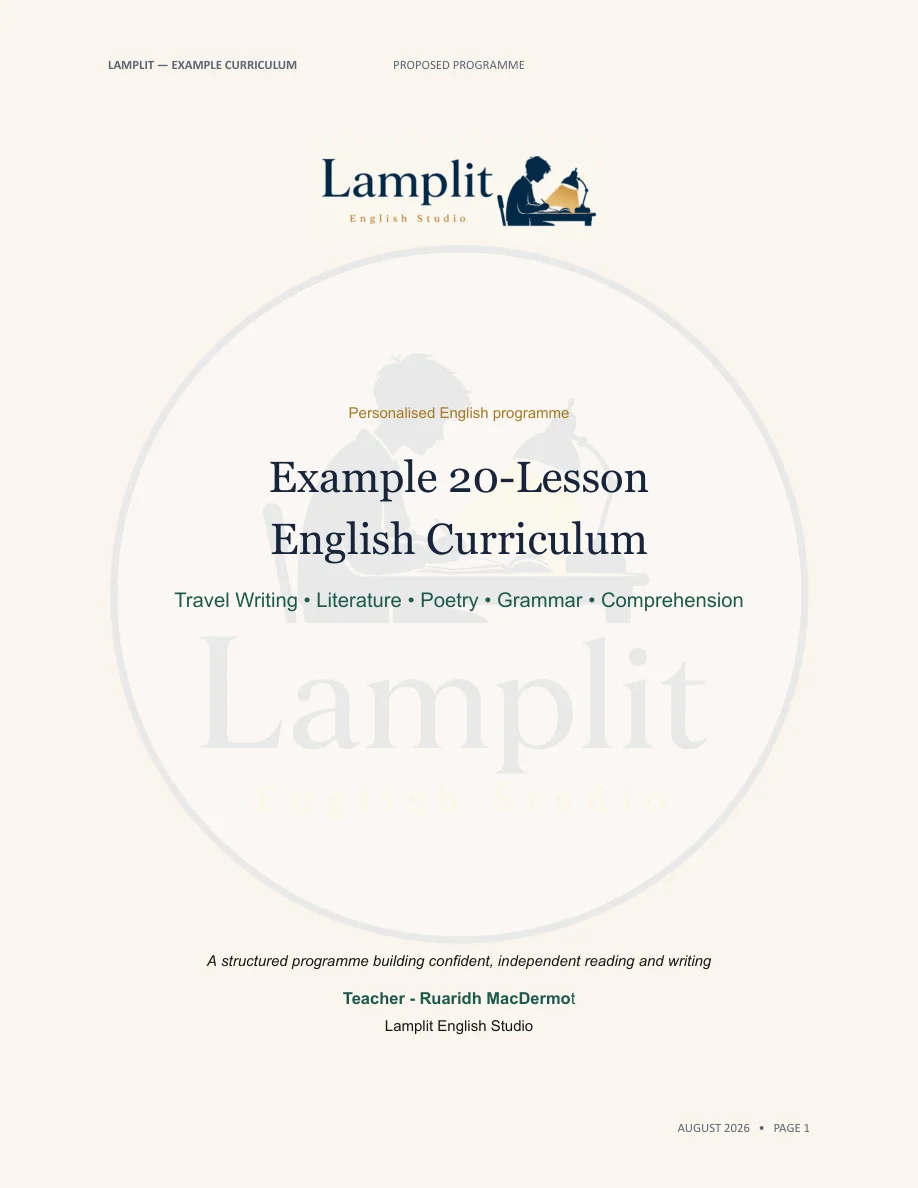
Lamplit example 20-lesson English curriculum cover, with the studio logo on cream paper.
Read the full example curriculum →20 lessons · Opens in Google Docs
  1. Lessons 1–5

    Travel writing

    Turn Paris and Rome holiday writing into a finished travel journal. Develop description, audience awareness and organisation through careful redrafting.

    Working towards

    A polished travel journal and guide.

  2. Lesson 6

    Poetry: journey and the sea

    Read John Masefield’s Sea Fever aloud and explore its imagery, rhythm and repeated sounds. Its seafaring theme provides a bridge into the novel.

    Working towards

    An analytical paragraph explaining the poet’s choices.

  3. Lessons 7–16

    Kensuke’s Kingdom

    Move from close reading and inference to viewpoint, character and whole-novel interpretation. Gather evidence and develop a sustained response about Michael and Kensuke’s friendship.

    Working towards

    A planned, written and revised literary essay.

  4. Lessons 17–20

    Poetry and comparison

    Explore Island Man, Wind and The Highwayman, then bring the reading and writing skills together through comparison and an independent response.

    Working towards

    A comparative poetry essay and reflection.

Grammar, comprehension and independent editing run throughout: tense and cohesion in the travel journal, careful inference in the novel, and evidence and explanation in poetry.

See how the novel study developed in lessons →
Look inside one planned lesson: meeting Kensuke
Reading focus
Separate what Michael knows from what he assumes, then use evidence to infer Kensuke’s motives.
Language focus
Use modal verbs such as “may”, “might” and “must” to express different degrees of certainty.
Written response
Explain why Kensuke initially appears threatening or mysterious, using cautious, accurate analytical language.
Between lessons
Reread a key section and consider what Kensuke may think about Michael.

Ages 6–8

English Foundations

Parent concern
A child may be finding early reading, spelling or sentence writing difficult, or may understand more than they can confidently express. Parents may be worried that small gaps are beginning to affect confidence, fluency or enjoyment.
Core skills
Phonics and spelling patterns; accurate, expressive reading; comprehension and vocabulary; sentence construction; capital letters and punctuation; and early creative and non-fiction writing.
Example activities
Reading a short text aloud and discussing its meaning; sorting words by spelling pattern; improving a simple sentence with precise vocabulary; sequencing a story; and writing a short description or paragraph before revising it together.
Expected outcomes
Students become more accurate and fluent readers, write clearer sentences, explain their understanding with greater confidence and begin checking their own work more independently.
Who it suits
For children who need secure foundations, focused support in a particular area or greater challenge beyond schoolwork. Suitable for native English speakers and students developing English as an additional language.

Ages 9–11

Confident Readers and Writers

Parent concern
A child may read confidently but find inference difficult, produce good ideas without organising them clearly, or make recurring grammar and punctuation errors. Others may need greater challenge, preparation for secondary school or focused 11+ support.
Core skills
Reading comprehension and inference; selecting evidence; vocabulary and grammar; paragraphing and cohesion; creative and non-fiction writing; introductory literary analysis; and purposeful editing.
Example activities
Annotating a passage for clues; explaining an answer with evidence; mapping a story’s structure and character arc; expanding and combining sentences; planning a multi-paragraph response; and improving a first draft through discussion and revision.
Expected outcomes
Students give better-supported reading answers, organise writing more clearly, use increasingly precise vocabulary and grammar, and revise their work with greater independence.
Who it suits
For upper-primary students who need targeted support, more demanding English work, preparation for school transition or selective-entry assessments, or structured development alongside a British, American or international curriculum.

Ages 12–14

Literature and Composition

Parent concern
A student may understand a text in discussion but struggle to turn ideas into a clear analytical paragraph or essay. Their writing may need stronger structure, better evidence, more precise language or a more mature and controlled style.
Core skills
Close reading; analysis of language, structure and atmosphere; thesis statements and argument; selecting and integrating evidence; analytical paragraph and essay structure; advanced grammar and vocabulary; and developed creative writing.
Example activities
Tracing how atmosphere changes through a chapter; annotating a short extract for a writer’s choices; planning and defending an interpretation; integrating a quotation; comparing two possible readings; and revising a paragraph for precision and depth.
Expected outcomes
Students form clearer interpretations, structure arguments logically, use evidence effectively, explain how writers create meaning and produce more mature analytical and creative writing.
Who it suits
For lower-secondary students who need stronger foundations in analysis and composition, support with school essays or assessments, or sustained challenge through demanding literature and independent writing.

Ages 15–16

Advanced English

Parent concern
A student may have thoughtful ideas but need greater precision, independence and control in examination or academic writing. They may need help sustaining an argument, comparing texts, analysing subtle effects or editing under time pressure.
Core skills
Advanced comprehension and critical interpretation; comparative analysis; analytical essay structure; concise use of evidence; academic expression; independent planning and editing; and examination-style practice where appropriate.
Example activities
Developing a thesis from an open question; comparing interpretations or extracts; selecting the strongest evidence; refining an analytical paragraph; planning a timed response; and using feedback to edit for clarity, economy and sophistication.
Expected outcomes
Students write more coherent and persuasive essays, analyse texts with greater precision, make confident independent choices and approach demanding assignments or assessments with a reliable process.
Who it suits
For students aged 15–16 seeking focused support with advanced reading and writing, preparation for school examinations, or greater academic challenge within a British, American or international curriculum.

These programmes are examples, not fixed packages. Lessons may follow a particular curriculum or combine carefully selected materials according to the student’s needs.

Free parent consultation

Ready to talk about your child’s English?

Begin with a free parent consultation to discuss your child’s learning, current needs and goals.